
vitamine -
Folic Acid vs Methylfolate: Why it Matters
The key difference between methylfolate vs folic acid is that methylfolate is the biologically active, natural form of vitamin B9 that the body can use immediately, whereas folic acid is a synthetic form that must be converted by an enzyme called MTHFR. This conversion process ca
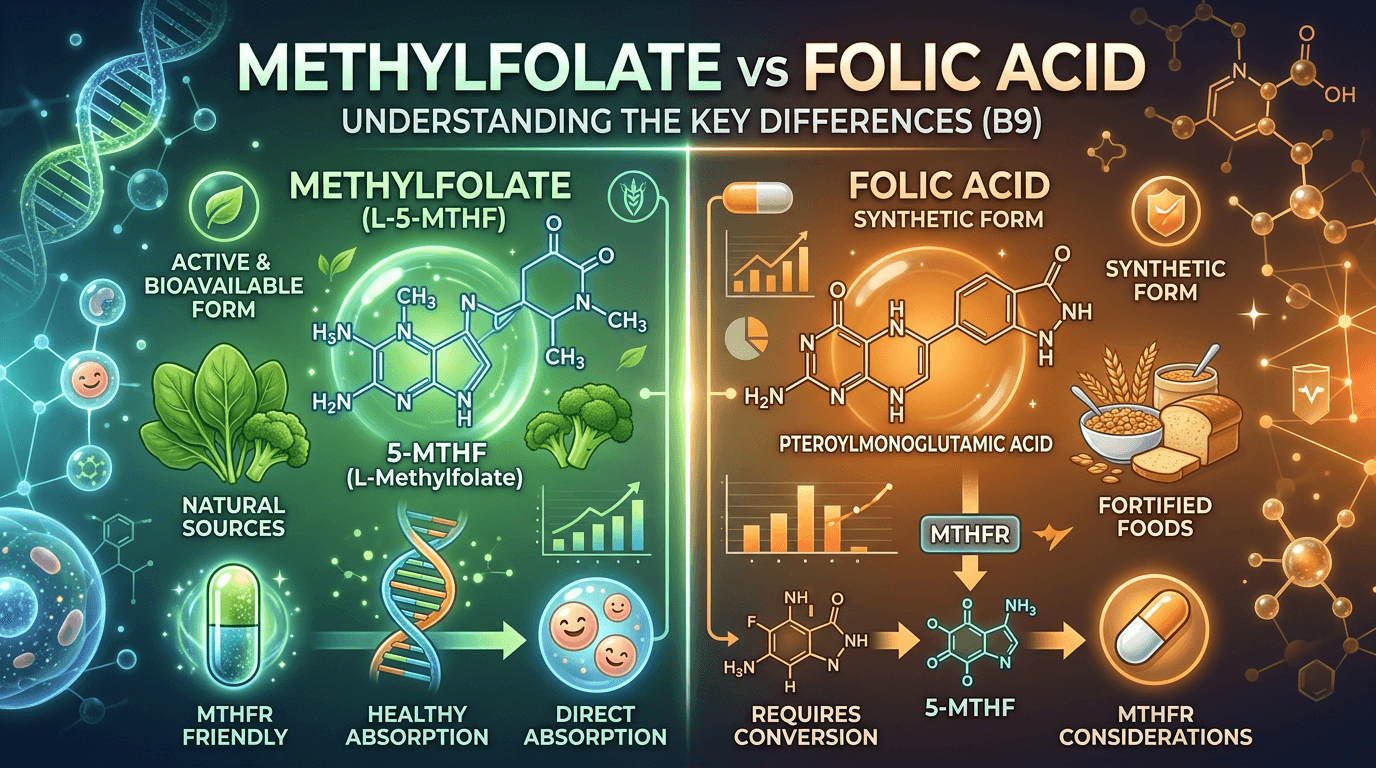
The key difference between methylfolate vs folic acid is that methylfolate is the biologically active, natural form of vitamin B9 that the body can use immediately, whereas folic acid is a synthetic form that must be converted by an enzyme called MTHFR. This conversion process can be inefficient for a significant portion of the U.S. population due to common genetic variations, making methylfolate a more direct and potentially more effective source of folate for some individuals.
Understanding the distinction between these two forms of vitamin B9 is crucial for making informed decisions about supplementation, especially for pregnancy, mood support, and overall cellular health. This article provides a detailed comparison of folic acid and methylfolate, exploring the science of folate metabolism, the role of the MTHFR gene, and practical guidance for choosing the right form for your individual needs, all based on current scientific understanding.
What is Folate and Why is it Essential?

Folate is the general term for vitamin B9, an essential water-soluble nutrient that plays a fundamental role in human health from the moment of conception. Your body cannot produce folate on its own, so it must be obtained through diet or supplementation. It is indispensable for some of the most basic and critical processes that sustain life and support growth and development.
At its core, folate is a key player in one-carbon metabolism. This means it helps transfer single carbon units within cells, a process vital for numerous biochemical reactions. The most well-known functions of folate include:
- DNA Synthesis and Repair: Folate is necessary for the creation and repair of DNA, the genetic blueprint inside every cell. Without adequate folate, cells cannot divide and replicate properly, which can impact tissues with high cell turnover rates like skin, the gut lining, and bone marrow.
- Cell Division and Growth: Because of its role in DNA synthesis, folate is critical during periods of rapid growth, such as pregnancy, infancy, and adolescence. This is why it is so heavily emphasized for preventing birth defects.
- Red Blood Cell Formation: Folate works alongside vitamin B12 to help form healthy red blood cells in the bone marrow. A deficiency can lead to a type of anemia called megaloblastic anemia, characterized by large, immature red blood cells that cannot effectively carry oxygen.
- Homocysteine Metabolism: Folate is a crucial component in the process that converts an amino acid called homocysteine into methionine. Elevated homocysteine levels are considered a risk factor for various health concerns, and maintaining adequate folate status is key to keeping them in check.
- Neurotransmitter Synthesis: The active form of folate, methylfolate, is involved in the production of key neurotransmitters like serotonin, dopamine, and norepinephrine. These chemical messengers are essential for mood regulation, focus, and overall brain function.
The term "folate" encompasses all various forms of vitamin B9, including those found naturally in foods (food folate), the synthetic form used in fortification (folic acid), and the active form used by the body (methylfolate). Understanding the differences between these forms is the first step toward appreciating why the "folic acid vs. methylfolate" debate exists.
Understanding Folic Acid: The Synthetic Form

Folic acid is a synthetic, oxidized form of vitamin B9 that is not found in nature. It was created in a laboratory in the 1940s and is known for its exceptional stability, making it ideal for fortifying processed foods and for use in multivitamin supplements. Its introduction into the food supply represents one of the most successful public health interventions in modern history.
In the 1990s, compelling evidence demonstrated that low maternal folate levels were a primary cause of neural tube defects (NTDs), severe birth defects of the brain and spine like spina bifida and anencephaly. In response, the U.S. Food and Drug Administration (FDA) mandated that all enriched cereal grain products—such as bread, pasta, rice, and breakfast cereals—be fortified with folic acid, starting in 1998. This single action led to a significant decrease in the incidence of NTDs in the United States.
However, it is critical to understand that folic acid is not biologically active. When you consume folic acid from a supplement or fortified food, your body must convert it into the active form, L-5-methyltetrahydrofolate (L-5-MTHF), before it can be used. This multi-step conversion process primarily relies on an enzyme in the liver called methylenetetrahydrofolate reductase, or MTHFR.
| Common Foods Fortified with Folic Acid in the U.S. | |
|---|---|
| Enriched White Bread | The "enriched" label indicates folic acid has been added. |
| Breakfast Cereals | Many, but not all, cereals are fortified. Check the nutrition label. |
| Enriched Pasta and Noodles | Includes most standard dry pasta products. |
| Enriched White Rice | Brown rice is typically not enriched. |
| Corn Masa Flour | Used to make tortillas, chips, and tamales (fortification added more recently). |
| Enriched Flour | Used in a wide variety of baked goods, crackers, and snacks. |
While the fortification program has been a resounding success for public health, it also means that many Americans have a high, continuous intake of synthetic folic acid. This has raised questions about how efficiently the body processes it and whether there are any potential downsides for individuals who struggle with the conversion process.
Understanding Methylfolate (L-5-MTHF): The Body-Ready Form
Methylfolate, specifically L-5-methyltetrahydrofolate (L-5-MTHF), is the most biologically active and prevalent form of folate found in the human body and in natural food sources. Unlike folic acid, which is a man-made precursor, methylfolate is the finished product—the form your cells can use immediately without needing any conversion.
Think of it like this: folic acid is like raw lumber that needs to be measured, cut, and assembled before it can be used to build a house. Methylfolate is like a prefabricated, ready-to-install wall frame. It bypasses the entire construction process and can be put to work right away. This is a crucial distinction. When you consume foods naturally rich in folate, such as leafy greens, legumes, and avocados, you are primarily consuming various forms of methylfolate and other related compounds that are easily absorbed and utilized.
Methylfolate's primary roles in the body are directly linked to its "methyl" group. It acts as a primary "methyl donor" in a fundamental biological process called methylation. Methylation is a switch that turns genes on and off, helps detoxify chemicals, builds neurotransmitters, processes hormones, and protects DNA. Methylfolate delivers its methyl group to countless reactions, including:
- Regulating Homocysteine: Methylfolate donates its methyl group to convert potentially harmful homocysteine back into the beneficial amino acid methionine.
- Creating Neurotransmitters: The synthesis of serotonin, dopamine, and norepinephrine depends on methylation reactions fueled by methylfolate.
- Producing Energy: It plays a role in the creation of Coenzyme Q10 and carnitine, both essential for cellular energy production.
- Supporting Detoxification: Methylation is a key step in the liver's phase II detoxification pathway, helping to neutralize and excrete toxins.
Because methylfolate is already in the active form, it circumvents the entire folic acid conversion pathway. This means its effectiveness does not depend on the efficiency of the MTHFR enzyme. For this reason, methylfolate supplements are often considered a more direct and reliable way to increase the body's active folate levels, especially for individuals who may have difficulty processing synthetic folic acid.
The Core Difference: The MTHFR Gene and Folate Metabolism
The central reason for the debate between folic acid and methylfolate lies in the MTHFR gene and the enzyme it produces. This gene provides the instructions for making the methylenetetrahydrofolate reductase (MTHFR) enzyme. The primary job of this enzyme is to perform the final and most critical step in converting folic acid into active methylfolate.
The conversion pathway is a multi-step process, but the MTHFR enzyme is the rate-limiting step. If this enzyme works slowly or inefficiently, the entire production line for active folate gets backed up. This is where genetics come into play. Many people have common variations, or polymorphisms, in their MTHFR gene. These are not "mutations" in the sense of causing a disease, but rather normal genetic differences, like having blue eyes or brown eyes.
However, some of these variations can affect the structure and function of the MTHFR enzyme, reducing its ability to convert folic acid into methylfolate. The two most studied MTHFR polymorphisms are:
- C677T: Individuals with one copy of this variant (heterozygous) may have a roughly 30% reduction in MTHFR enzyme function. Those with two copies (homozygous) can experience up to a 60-75% reduction in enzyme activity.
- A1298C: This variant is generally associated with a more modest decrease in enzyme function compared to C677T.
It's estimated that up to 60% of the U.S. population has at least one copy of an MTHFR variant, with varying degrees of impact on enzyme function. For these individuals, relying solely on folic acid from fortified foods and supplements may not be the most effective strategy. Their bodies may struggle to produce enough active methylfolate, even when their intake of folic acid is high. This can lead to a paradoxical situation: having plenty of folic acid in the bloodstream but not enough of the active form for the cells to use.
This genetic factor is the main reason why methylfolate is presented as an alternative. Since methylfolate is already the "finished product," it completely bypasses the need for MTHFR conversion. It provides a direct supply of the active folate the body needs, regardless of an individual's genetic makeup or MTHFR enzyme efficiency.
Potential Concerns with Unmetabolized Folic Acid (UMFA)
When the body's capacity to convert folic acid into methylfolate is overwhelmed, unconverted folic acid can build up in the bloodstream. This is known as unmetabolized folic acid (UMFA). The presence of UMFA in the blood is a relatively new phenomenon, becoming widespread only after the implementation of mandatory folic acid fortification in the late 1990s.
The MTHFR conversion process is relatively slow and can become saturated, especially with single large doses of folic acid (typically over 200-400 mcg). For individuals with reduced MTHFR enzyme function due to genetic variations, this saturation point may be reached even more quickly. While the long-term health implications of chronic, low-level UMFA are still being investigated and are a subject of scientific debate, several potential concerns have been raised.
One of the most well-established concerns is the potential for high folic acid intake to mask a vitamin B12 deficiency. Folate and vitamin B12 are closely linked. A deficiency in either can cause megaloblastic anemia. Supplementing with high doses of folic acid can correct the anemia aspect of a B12 deficiency, making the blood work appear normal. However, it does not address the underlying B12 deficiency, which can continue to cause irreversible neurological damage if left untreated. This masking effect can delay diagnosis and treatment of a serious condition. This is why it is often recommended to take B12 alongside folate and to have B12 levels checked before starting high-dose folate supplementation.
Other areas of research, though less conclusive, explore potential links between high levels of UMFA and other health issues. Some studies have investigated whether UMFA could interfere with the function of natural food folates or potentially impact the immune system. It's important to stress that this is an area of active research, and no definitive causal links have been established for most of these concerns. The scientific community has not reached a consensus on the clinical significance of UMFA for the general population. However, the theoretical risk is another factor that leads some clinicians and individuals to prefer methylfolate, which does not contribute to UMFA levels.
Who Might Consider Methylfolate Over Folic Acid?
While folic acid remains a viable and effective option for many, certain individuals may benefit from discussing methylfolate with their healthcare provider. The decision to choose methylfolate is highly individualized and should be based on factors like genetics, lab results, health history, and response to previous supplementation. It is not a one-size-fits-all solution, but a targeted approach for specific situations.
Groups who might find methylfolate to be a more suitable choice include:
- Individuals with MTHFR Gene Variations: This is the most straightforward reason. For those with known homozygous or compound heterozygous MTHFR polymorphisms that significantly reduce enzyme function, using methylfolate bypasses the metabolic roadblock, ensuring a direct supply of active folate.
- People with Elevated Homocysteine Levels: High homocysteine is a risk factor for several health conditions. Since methylfolate is essential for converting homocysteine to methionine, providing the active form directly can be a very effective strategy for lowering elevated levels, often in conjunction with vitamins B6 and B12.
- Those with Absorption Issues: Individuals with digestive conditions that affect nutrient absorption in the small intestine might benefit from the more readily absorbed and utilized form of folate.
- Individuals with Certain Mood-Related Concerns: Research has explored the link between low folate levels and mood. Since methylfolate is required for the synthesis of key neurotransmitters like serotonin and dopamine, some studies have investigated L-methylfolate as an adjunctive therapy in mood management, particularly for those who don't respond well to other interventions. This is a complex area, and supplementation should only be done under medical supervision.
- Those Who Don't Feel Well on Folic Acid: Anecdotally, some individuals report feeling unwell (e.g., experiencing anxiety, irritability, or headaches) when taking supplements containing folic acid, but feel better when switching to methylfolate. While not fully understood, this could be related to the buildup of UMFA or other metabolic effects.
- Older Adults: Some research suggests that folate metabolism may become less efficient with age. Combined with a higher prevalence of conditions that can be masked by high folic acid intake (like B12 deficiency), some older adults may be good candidates for methylfolate.
Choosing methylfolate is not about labeling folic acid as "bad." Folic acid is a proven and important public health tool. Instead, the choice is about personalization. For those with specific genetic or health factors, methylfolate can represent a more precise and efficient way to meet the body's need for this critical vitamin.
Folic Acid vs. Methylfolate in Pregnancy
Nowhere is the folate conversation more critical than in pregnancy. Adequate folate status before conception and during the first trimester is absolutely essential for preventing neural tube defects (NTDs). The evidence supporting the role of folic acid in preventing NTDs is overwhelming and forms the basis of public health recommendations worldwide. For decades, the clear and consistent message to women of childbearing age has been to take 400-800 mcg of folic acid daily.
This raises a crucial question: in the context of pregnancy, is methylfolate a better choice? The answer is complex and evolving. Here's a breakdown of the current landscape:
The Case for Folic Acid in Pregnancy
- Proven Efficacy: Virtually all the large-scale clinical trials that established the link between folate supplementation and NTD prevention used folic acid. Its success is documented and undeniable.
- Public Health Standard: Because of its proven track record, folic acid remains the standard of care recommended by major health organizations like the American College of Obstetricians and Gynecologists (ACOG) and the Centers for Disease Control and Prevention (CDC).
The Case for Methylfolate in Pregnancy
- Biological Plausibility: Logically, providing the body's active form of folate makes sense. It bypasses the MTHFR conversion step, which could be particularly important for the estimated 40-60% of women with a genetic variation that slows this process.
- Potentially Higher Blood Folate Levels: Some studies suggest that supplementation with methylfolate can lead to higher concentrations of active folate in red blood cells compared to an equivalent dose of folic acid, which may be beneficial.
- Avoids UMFA: Using methylfolate ensures that there is no buildup of unmetabolized folic acid, avoiding the theoretical concerns associated with it.
While the biological argument for methylfolate is strong, it lacks the decades of large-scale human trial data that folic acid has for NTD prevention specifically. However, a growing body of evidence and expert consensus agrees that methylfolate is at least as effective as folic acid in raising blood folate levels. Since raising blood folate is the mechanism by which NTDs are prevented, it is widely believed that methylfolate offers equivalent protection.
As a result, many modern, high-quality prenatal vitamins have already made the switch from folic acid to methylfolate. This is seen by many practitioners as a proactive step that accounts for individual genetic variability without any known downside. The most important thing is ensuring adequate intake of *some* form of folate.
| Comparison for Pregnancy | Folic Acid | Methylfolate (L-5-MTHF) |
|---|---|---|
| NTD Prevention Data | Extensive, gold-standard evidence from decades of research. | Considered equally effective based on its ability to raise blood folate; direct NTD trials are fewer. |
| Metabolism | Requires conversion by the MTHFR enzyme. Can be inefficient for many. | Biologically active. Bypasses the MTHFR enzyme, making it universally usable. |
| Unmetabolized Form | Can lead to Unmetabolized Folic Acid (UMFA) in the blood. | Does not contribute to UMFA levels. |
| Recommendation | Standard recommendation by CDC/ACOG. Well-established and effective. | Increasingly used in modern prenatals and recommended by many functional/integrative practitioners. |
Dosage, Forms, and How to Choose a Supplement
Navigating folate supplementation requires understanding dosage units, different chemical forms, and how to read a label correctly. Recommendations are given in Dietary Folate Equivalents (DFE) to account for the different absorption rates of folate from food versus synthetic folic acid.
The general Recommended Dietary Allowance (RDA) for adults is 400 mcg DFE per day. For pregnant and lactating women, this increases to 600 mcg DFE and 500 mcg DFE, respectively. The conversion is as follows:
- 1 mcg food folate = 1 mcg DFE
- 1 mcg folic acid taken with food (from fortified foods) = 1.7 mcg DFE
- 1 mcg folic acid taken on an empty stomach (from a supplement) = 2 mcg DFE
This shows that folic acid is much more bioavailable than natural food folate, which is why the DFE system was created. Methylfolate is generally considered to be at least as bioavailable as folic acid, and for labeling purposes, 1 mcg of methylfolate is often equated to 1 mcg of folic acid (and thus 1.7 mcg DFE).
How to Read a Supplement Label for Methylfolate
Choosing a methylfolate supplement can be confusing due to complex chemical names. Here’s what to look for on the "Supplement Facts" panel:
- Check the ingredient line for "Folate."
- Look at the name in the parentheses. This will tell you the specific form used. Avoid products that just say "folate" without specifying the form, or that list only "folic acid" if you are specifically looking for the active form.
- Identify names for methylfolate. Look for terms like:
- L-5-methyltetrahydrofolate or L-5-MTHF
- (6S)-5-methyltetrahydrofolate
- L-methylfolate calcium
- Recognize branded forms. Many high-quality supplements use patented, branded forms of methylfolate that have been studied for stability and bioavailability. These include:
- Metafolin®: A calcium salt form of L-5-MTHF.
- Quatrefolic®: A glucosamine salt form of (6S)-5-MTHF, known for its high solubility and stability.
If you see any of these names, you can be confident you are getting the active, methylated form of folate. Dosages in supplements typically range from 400 mcg to 1,000 mcg (1 mg), with higher therapeutic doses available by prescription. It is unwise to take high doses without medical supervision.
Potential Side Effects and Safety Considerations
Folate, in both its natural and synthetic forms, is a water-soluble vitamin. This means that any excess is typically excreted in the urine, and it is generally considered very safe with a low risk of toxicity. However, there are important safety considerations, particularly with high-dose supplementation.
The main safety concern, as previously mentioned, applies primarily to high doses of folic acid:
- Masking Vitamin B12 Deficiency: High intake of folic acid (>1,000 mcg/day) can correct the anemia associated with vitamin B12 deficiency, but it does not address the neurological damage that can occur. This can lead to a dangerous delay in diagnosing and treating the B12 deficiency. Methylfolate is thought to be less likely to mask a B12 deficiency, but caution is still warranted. Anyone considering high-dose folate should have their B12 status checked first.
To address this, the Food and Nutrition Board at the Institute of Medicine established a Tolerable Upper Intake Level (UL) for synthetic folate (folic acid) of 1,000 micrograms (mcg) per day for adults. This UL applies only to folic acid from fortified foods and supplements, not to the folate naturally found in food. An UL for methylfolate has not been established, but this does not mean that unlimited amounts are safe. Prudence should always be exercised with high-dose supplementation.
Some people may experience mild side effects when first starting methylfolate, particularly at higher doses. These can include:
- Anxiety, irritability, or overstimulation
- Insomnia
- Headaches
- Acne or rashes
These effects are often related to the sudden increase in methylation activity and are sometimes referred to as "start-up" effects. They can often be mitigated by starting with a very low dose and increasing it slowly over time, and ensuring adequate intake of other B vitamins that work with folate. If you experience persistent or severe side effects, you should stop taking the supplement and consult your healthcare provider.
Common Mistakes When Choosing Between Folic Acid and Methylfolate
Making an informed choice about folate requires navigating a lot of nuanced information. It's easy to make mistakes based on incomplete or misunderstood advice. Here are some common pitfalls to avoid:
- Assuming "Folate" on a Label Means It's the Natural Form. Many supplement manufacturers use the term "folate" on the front of the bottle, but the supplement facts panel reveals the form is actually folic acid. Always read the back of the label to verify the specific compound used.
- Self-Diagnosing an MTHFR Issue and Self-Prescribing High Doses. While online information can be empowering, it's not a substitute for professional medical advice. Assuming you have a problematic MTHFR variant based on symptoms alone can be misleading. Starting high-dose methylfolate without guidance can lead to side effects and may obscure other underlying health issues.
- Switching Forms During Pregnancy Without Medical Approval. While methylfolate is increasingly common in prenatal vitamins, if you are pregnant and your doctor has prescribed a specific supplement with folic acid, do not switch to a methylfolate product without a thorough discussion and their explicit approval. Consistency and medical supervision are key during this critical time.
- Believing Supplements Are a Substitute for a Healthy Diet. No supplement can replace the benefits of a diet rich in natural food folate. Leafy greens, beans, lentils, and citrus fruits provide not just folate but a whole matrix of vitamins, minerals, and phytonutrients that work together. Supplements should complement, not replace, a nutritious diet.
- Thinking Methylfolate is a "Magic Bullet." Methylfolate is a powerful and important tool for many people, but it's not a cure-all. It works as part of a complex system with other B vitamins (especially B6 and B12), magnesium, and other nutrients. Addressing only one piece of the puzzle may not yield the desired results. A holistic approach is always best.
Frequently Asked Questions
Is methylfolate better than folic acid for everyone?
No, not necessarily. Folic acid is effective for a large portion of the population and has a long history of safe use in public health initiatives. Methylfolate is primarily considered "better" for individuals with MTHFR gene variations or other specific conditions that impair the conversion of folic acid to its active form. For these individuals, methylfolate is a more direct and reliable choice.
How do I know if I have an MTHFR gene variation?
The only way to know for sure is through genetic testing. This can be ordered by a healthcare provider. Some consumer-facing genetic testing companies also provide this information, but the results should always be interpreted with the help of a qualified professional who understands the clinical implications.
Can I get enough methylfolate from food?
Yes, a diet rich in folate-containing foods provides methylfolate and other natural folates. Excellent sources include leafy greens (spinach, romaine lettuce), legumes (lentils, beans), asparagus, broccoli, and avocados. However, natural food folates can be unstable and are easily destroyed by heat and processing, so getting a consistent, high therapeutic amount from diet alone can be challenging.
What are the signs of folate deficiency?
Signs of folate deficiency can be subtle and overlap with other conditions. They may include fatigue, weakness, pale skin, shortness of breath, irritability, difficulty concentrating, and sores on the tongue or in the mouth. Since these symptoms are non-specific, it's essential to see a doctor for proper diagnosis through blood tests rather than self-diagnosing.
What is folinic acid and how is it different?
Folinic acid (also called 5-formyltetrahydrofolate) is another form of folate that is further along the conversion pathway than folic acid but is not yet the final methylated form. It can be converted into methylfolate without the MTHFR enzyme, making it another useful alternative for some people. It is often used in specific medical situations and is available by prescription or as a supplement.
Can I take methylfolate if my multivitamin already has folic acid?
This is a question best answered by your healthcare provider. Taking both increases your total intake of B9, and the combined amount should be considered. Many people with MTHFR variations choose to replace their folic acid-containing multivitamin with one that uses methylfolate to avoid the conversion issue and potential for UMFA buildup.
Does methylfolate cause anxiety?
For some individuals, especially when starting a high dose, methylfolate can cause feelings of anxiety, irritability, or overstimulation. This is often due to a rapid increase in the production of neurotransmitters. It is generally recommended to start with a low dose and increase slowly to allow your body to adjust. If these feelings persist, consult your practitioner.
Why do some supplements have such high doses of methylfolate (like 15 mg)?
Very high doses of L-methylfolate, such as 7.5 mg and 15 mg, are classified as "medical foods" and are intended for use under medical supervision as an adjunctive therapy for specific conditions, such as depression. These are not standard supplemental doses for general health and should not be taken without a prescription and guidance from a doctor.
Conclusion: An Era of Personalized Nutrition
The conversation about folic acid vs. methylfolate marks a significant shift in our understanding of nutrition—from a one-size-fits-all approach to a more personalized one. Folic acid remains a public health triumph, a stable and effective tool that has dramatically reduced the incidence of neural tube defects and improved folate status for millions.
However, the discovery of the MTHFR gene's role in folate metabolism has illuminated why this approach may not be optimal for everyone. For the substantial portion of the population with less efficient MTHFR enzymes, synthetic folic acid may not be the most effective way to raise levels of active folate in the body. For these individuals, methylfolate offers a direct, body-ready solution that bypasses this common metabolic hurdle.
Ultimately, the choice is not about declaring one form "good" and the other "bad." It is about understanding the biological context and making an informed decision based on individual genetics, health status, and specific goals. Whether you are planning a pregnancy, managing homocysteine levels, or simply aiming for optimal wellness, understanding the difference between these two forms of vitamin B9 is key. The best path forward is always one that is guided by knowledge and undertaken in partnership with a trusted healthcare professional who can help you choose the right form, and the right dose, for you.